Guide · Water · 6 minute read
How much water per person
One gallon per person per day. Half of it to drink, half to cook and wash with. That is the figure every emergency agency in the country uses, and after a decade of selling food that needs water to cook, it is the figure we use too.
The count
Multiply the people in the house by the days you want to cover, then by one gallon. A household of four covering two weeks needs 56 gallons. That sounds like a lot until you see it stacked: it is eleven 5 gallon containers, or a column of 1 gallon jugs along one wall of a closet.
| Household | 3 days | 1 week | 2 weeks |
|---|---|---|---|
| 1 person | 3 gallons | 7 gallons | 14 gallons |
| 2 people | 6 gallons | 14 gallons | 28 gallons |
| 4 people | 12 gallons | 28 gallons | 56 gallons |
| 6 people | 18 gallons | 42 gallons | 84 gallons |
Add for cooking
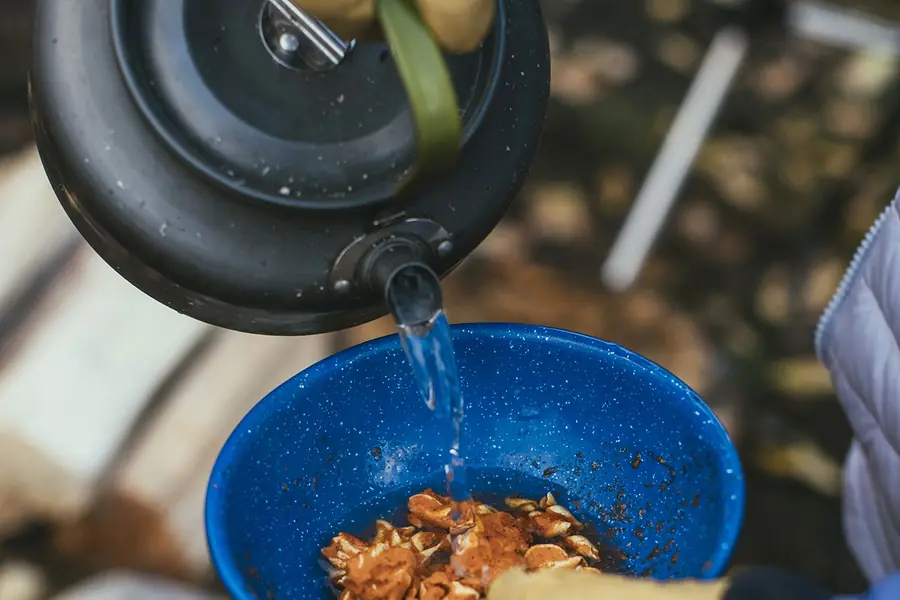
Freeze dried meals take about one cup of water per serving. At three meals and a drink a day that is roughly half a gallon per person, and it is already inside the one gallon figure. If you run hot, work outdoors or live somewhere that hits 100°F, plan on a gallon and a half.
Three ways to store it
Bottled water, by the case
Cheapest to start and easiest to rotate. A case of 24 half litre bottles is just over three gallons. Keep it off concrete floors and out of sunlight, and it is good for two years from the date on the pack.
Stackable containers
Five and seven gallon food grade containers stack two high and fit under a workbench. Fill from the tap, add the dose of unscented bleach on the label, and change the water once a year on a day you will remember, like the clocks going back.
A tank you do not have to lift
Above about 50 gallons, move to a single tank with a spigot. A 55 gallon drum on a stand covers four people for two weeks and takes up one square yard of garage.
Treating water you find
When the stored water runs out, a gravity filter turns a bathtub, a pool or a creek into drinking water at a gallon every few minutes with no power and no pumping. Keep one, and keep the bleach for the containers.
Water first. A food kit without water is a box of powder.
Where to start
- Count the household and pick two weeks.
- Buy the cases this week and stack them somewhere cool.
- Add a filter, then start moving the bulk into containers as you find room.